AI Workforce Platform
Led end-to-end product, UX, and brand design for Verk, an AI-powered platform that enables businesses to build and manage a digital workforce of human-like AI employees. Owned research, product strategy, interaction design, and visual identity from concept to launch, focusing on reducing fear, complexity, and adoption friction around AI in the workplace.
March 1, 2024
AI Workforce Platform
Led end-to-end product, UX, and brand design for Verk, an AI-powered platform that enables businesses to build and manage a digital workforce of human-like AI employees. Owned research, product strategy, interaction design, and visual identity from concept to launch, focusing on reducing fear, complexity, and adoption friction around AI in the workplace.
March 1, 2024
CLIENT
Contlo
Role
Designer & PM
Service
Product Design
CLIENT
Contlo
Role
Designer & PM
Service
Product Design
CLIENT
Contlo
Role
Designer & PM
Service
Product Design

Context & Problem
What was Verk?
Verk was a new product initiative exploring how businesses could hire and work with AI employees such as AI Sales Reps, Designers, Marketers, and Recruiters. I worked across discovery, UX, UI, and branding to shape both the product experience and how AI employees were perceived.
The Problem
While interest in AI was growing, most businesses were hesitant to adopt AI employees due to fear of complexity, trust issues, and uncertainty around real-world value.
The core challenge was not technical capability, but adoption and perception:
AI felt abstract, intimidating, and hard to operationalise.
Hiring workflows for AI were unclear and unfamiliar.
Users struggled to understand what AI employees could realistically do and how they would fit into existing workflows.
The product needed to make AI feel approachable, human, and immediately useful.

Context & Problem
What was Verk?
Verk was a new product initiative exploring how businesses could hire and work with AI employees such as AI Sales Reps, Designers, Marketers, and Recruiters. I worked across discovery, UX, UI, and branding to shape both the product experience and how AI employees were perceived.
The Problem
While interest in AI was growing, most businesses were hesitant to adopt AI employees due to fear of complexity, trust issues, and uncertainty around real-world value.
The core challenge was not technical capability, but adoption and perception:
AI felt abstract, intimidating, and hard to operationalise.
Hiring workflows for AI were unclear and unfamiliar.
Users struggled to understand what AI employees could realistically do and how they would fit into existing workflows.
The product needed to make AI feel approachable, human, and immediately useful.
Context & Problem
What was Verk?
Verk was a new product initiative exploring how businesses could hire and work with AI employees such as AI Sales Reps, Designers, Marketers, and Recruiters. I worked across discovery, UX, UI, and branding to shape both the product experience and how AI employees were perceived.
The Problem
While interest in AI was growing, most businesses were hesitant to adopt AI employees due to fear of complexity, trust issues, and uncertainty around real-world value.
The core challenge was not technical capability, but adoption and perception:
AI felt abstract, intimidating, and hard to operationalise.
Hiring workflows for AI were unclear and unfamiliar.
Users struggled to understand what AI employees could realistically do and how they would fit into existing workflows.
The product needed to make AI feel approachable, human, and immediately useful.
Research & Insights
Research and discovery
To ground the product in real needs, I led early discovery through qualitative research.
Methods used:
Group discussions with 5–7 participants from business and hiring roles.
Competitive analysis of AI tools and hiring platforms.
Customer journey mapping to understand decision-making from awareness to deployment.
Key insights emerged consistently:
Users were overwhelmed by the number of tools and AI options.
There was skepticism about AI replacing or disrupting existing workflows.
Hiring quality talent, meeting targets, and scaling teams were persistent pain points.
This research shaped the direction of Verk as a guided, human-first AI workforce platform, rather than a generic AI tool.
Defining the product strategy
Based on research, I helped define three core principles:
Humanise AI
AI employees should feel like roles, not tools. Naming, personality, and clarity of skills were essential.Reduce cognitive load
Onboarding and setup needed to be simple, guided, and non-technical.Make value visible early
Users should quickly understand what each AI employee can do and see tangible outcomes.
This framing influenced everything from IA and flows to visual design and copy.


Research & Insights
Research and discovery
To ground the product in real needs, I led early discovery through qualitative research.
Methods used:
Group discussions with 5–7 participants from business and hiring roles.
Competitive analysis of AI tools and hiring platforms.
Customer journey mapping to understand decision-making from awareness to deployment.
Key insights emerged consistently:
Users were overwhelmed by the number of tools and AI options.
There was skepticism about AI replacing or disrupting existing workflows.
Hiring quality talent, meeting targets, and scaling teams were persistent pain points.
This research shaped the direction of Verk as a guided, human-first AI workforce platform, rather than a generic AI tool.
Defining the product strategy
Based on research, I helped define three core principles:
Humanise AI
AI employees should feel like roles, not tools. Naming, personality, and clarity of skills were essential.Reduce cognitive load
Onboarding and setup needed to be simple, guided, and non-technical.Make value visible early
Users should quickly understand what each AI employee can do and see tangible outcomes.
This framing influenced everything from IA and flows to visual design and copy.
Research & Insights
Research and discovery
To ground the product in real needs, I led early discovery through qualitative research.
Methods used:
Group discussions with 5–7 participants from business and hiring roles.
Competitive analysis of AI tools and hiring platforms.
Customer journey mapping to understand decision-making from awareness to deployment.
Key insights emerged consistently:
Users were overwhelmed by the number of tools and AI options.
There was skepticism about AI replacing or disrupting existing workflows.
Hiring quality talent, meeting targets, and scaling teams were persistent pain points.
This research shaped the direction of Verk as a guided, human-first AI workforce platform, rather than a generic AI tool.
Defining the product strategy
Based on research, I helped define three core principles:
Humanise AI
AI employees should feel like roles, not tools. Naming, personality, and clarity of skills were essential.Reduce cognitive load
Onboarding and setup needed to be simple, guided, and non-technical.Make value visible early
Users should quickly understand what each AI employee can do and see tangible outcomes.
This framing influenced everything from IA and flows to visual design and copy.
Product Strategy
UX flows and information architecture
I designed the core end-to-end experience:
Account creation and onboarding.
Browsing and hiring AI employees.
Understanding AI capabilities before commitment.
Managing AI employees post-hire.
Conversational interaction with AI employees.
Early wireframes were used to gather feedback from stakeholders and iterate on complexity, pricing clarity, and mental models around “hiring” AI versus using a SaaS feature.
Interaction model and AI experience
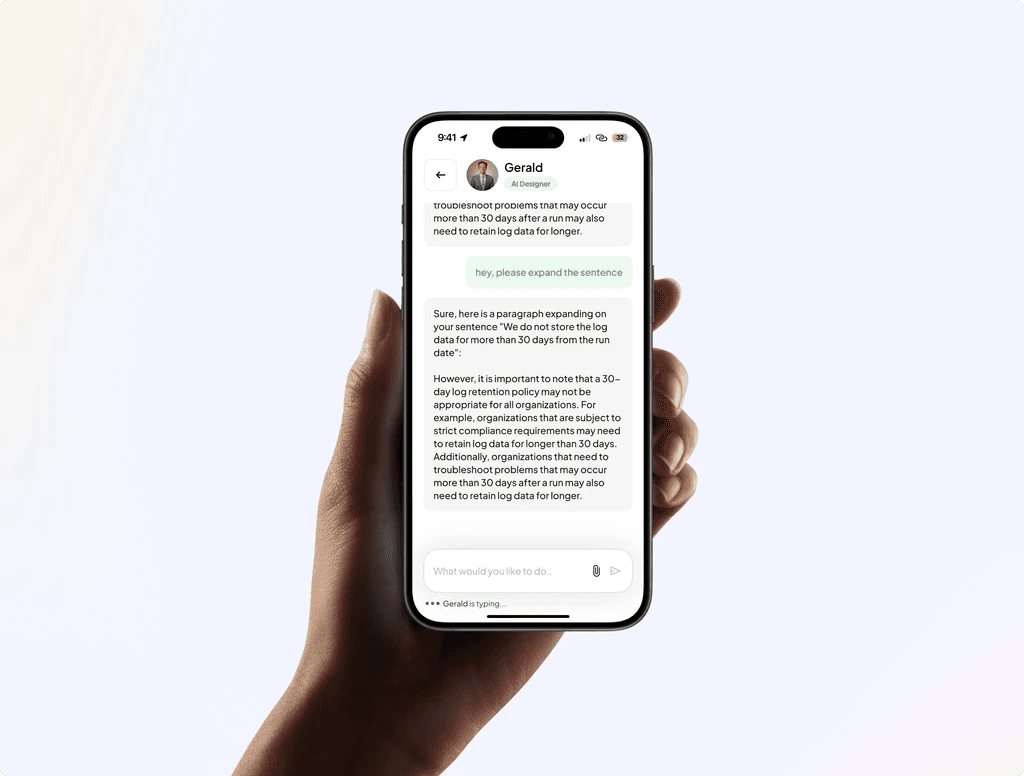
A key design decision was to allow users to interact with AI employees in a familiar, chat-based interface, reducing learning friction.
Design considerations included:
Clear explanations of what each AI employee could do.
Trial-based hiring to reduce commitment anxiety.
Transparent pricing and role-based differentiation.
Simple prompts and suggestions to guide interaction.
This made the experience feel closer to working with a teammate rather than configuring software.


Product Strategy
UX flows and information architecture
I designed the core end-to-end experience:
Account creation and onboarding.
Browsing and hiring AI employees.
Understanding AI capabilities before commitment.
Managing AI employees post-hire.
Conversational interaction with AI employees.
Early wireframes were used to gather feedback from stakeholders and iterate on complexity, pricing clarity, and mental models around “hiring” AI versus using a SaaS feature.
Interaction model and AI experience
A key design decision was to allow users to interact with AI employees in a familiar, chat-based interface, reducing learning friction.
Design considerations included:
Clear explanations of what each AI employee could do.
Trial-based hiring to reduce commitment anxiety.
Transparent pricing and role-based differentiation.
Simple prompts and suggestions to guide interaction.
This made the experience feel closer to working with a teammate rather than configuring software.
Product Strategy
UX flows and information architecture
I designed the core end-to-end experience:
Account creation and onboarding.
Browsing and hiring AI employees.
Understanding AI capabilities before commitment.
Managing AI employees post-hire.
Conversational interaction with AI employees.
Early wireframes were used to gather feedback from stakeholders and iterate on complexity, pricing clarity, and mental models around “hiring” AI versus using a SaaS feature.
Interaction model and AI experience
A key design decision was to allow users to interact with AI employees in a familiar, chat-based interface, reducing learning friction.
Design considerations included:
Clear explanations of what each AI employee could do.
Trial-based hiring to reduce commitment anxiety.
Transparent pricing and role-based differentiation.
Simple prompts and suggestions to guide interaction.
This made the experience feel closer to working with a teammate rather than configuring software.
Design Execution
Branding and visual identity
In parallel, I led the creation of Verk’s brand identity to reinforce approachability and trust.
Brand work included:
Visual identity and colour system.
Typography selection and hierarchy.
App store assets and marketing visuals.
Consistent component library across product surfaces.
The visual direction aimed to balance modern AI aesthetics with warmth and clarity, avoiding overly technical or futuristic cues that could intimidate users.
Testing and iteration
I conducted usability testing and feedback analysis to validate:
Onboarding clarity.
Comprehension of AI employee roles.
Ease of hiring and managing AI employees.
Confidence during first interactions.
Feedback helped refine copy, onboarding steps, and information hierarchy, ensuring users understood value without needing external explanation.
Design Execution
Branding and visual identity
In parallel, I led the creation of Verk’s brand identity to reinforce approachability and trust.
Brand work included:
Visual identity and colour system.
Typography selection and hierarchy.
App store assets and marketing visuals.
Consistent component library across product surfaces.
The visual direction aimed to balance modern AI aesthetics with warmth and clarity, avoiding overly technical or futuristic cues that could intimidate users.
Testing and iteration
I conducted usability testing and feedback analysis to validate:
Onboarding clarity.
Comprehension of AI employee roles.
Ease of hiring and managing AI employees.
Confidence during first interactions.
Feedback helped refine copy, onboarding steps, and information hierarchy, ensuring users understood value without needing external explanation.
Design Execution
Branding and visual identity
In parallel, I led the creation of Verk’s brand identity to reinforce approachability and trust.
Brand work included:
Visual identity and colour system.
Typography selection and hierarchy.
App store assets and marketing visuals.
Consistent component library across product surfaces.
The visual direction aimed to balance modern AI aesthetics with warmth and clarity, avoiding overly technical or futuristic cues that could intimidate users.
Testing and iteration
I conducted usability testing and feedback analysis to validate:
Onboarding clarity.
Comprehension of AI employee roles.
Ease of hiring and managing AI employees.
Confidence during first interactions.
Feedback helped refine copy, onboarding steps, and information hierarchy, ensuring users understood value without needing external explanation.
Outcome & Impact
Final solution
The final Verk experience enabled businesses to:
Browse, hire, and manage AI employees by role.
Understand AI capabilities before hiring.
Interact with AI employees through a familiar conversational interface.
Scale their digital workforce without complex setup.
The product was designed to be flexible, intuitive, and accessible even for non-technical users.
Impact and outcomes
Successfully shipped a 0→1 AI workforce product.
Established a clear mental model for “hiring” AI employees.
Reduced perceived complexity of AI adoption.
Delivered a cohesive product and brand system ready for go-to-market.
While metrics were early-stage, internal and stakeholder feedback validated the clarity and approachability of the experience.
My role and ownership
Owned end-to-end UX and product design from discovery to launch.
Led user research, journey mapping, and product strategy definition.
Designed IA, user flows, wireframes, and high-fidelity UI.
Defined the interaction model for AI employees.
Created the complete brand and visual identity system.
Partnered closely with stakeholders to balance ambition with usability.


Outcome & Impact
Final solution
The final Verk experience enabled businesses to:
Browse, hire, and manage AI employees by role.
Understand AI capabilities before hiring.
Interact with AI employees through a familiar conversational interface.
Scale their digital workforce without complex setup.
The product was designed to be flexible, intuitive, and accessible even for non-technical users.
Impact and outcomes
Successfully shipped a 0→1 AI workforce product.
Established a clear mental model for “hiring” AI employees.
Reduced perceived complexity of AI adoption.
Delivered a cohesive product and brand system ready for go-to-market.
While metrics were early-stage, internal and stakeholder feedback validated the clarity and approachability of the experience.
My role and ownership
Owned end-to-end UX and product design from discovery to launch.
Led user research, journey mapping, and product strategy definition.
Designed IA, user flows, wireframes, and high-fidelity UI.
Defined the interaction model for AI employees.
Created the complete brand and visual identity system.
Partnered closely with stakeholders to balance ambition with usability.
Outcome & Impact
Final solution
The final Verk experience enabled businesses to:
Browse, hire, and manage AI employees by role.
Understand AI capabilities before hiring.
Interact with AI employees through a familiar conversational interface.
Scale their digital workforce without complex setup.
The product was designed to be flexible, intuitive, and accessible even for non-technical users.
Impact and outcomes
Successfully shipped a 0→1 AI workforce product.
Established a clear mental model for “hiring” AI employees.
Reduced perceived complexity of AI adoption.
Delivered a cohesive product and brand system ready for go-to-market.
While metrics were early-stage, internal and stakeholder feedback validated the clarity and approachability of the experience.
My role and ownership
Owned end-to-end UX and product design from discovery to launch.
Led user research, journey mapping, and product strategy definition.
Designed IA, user flows, wireframes, and high-fidelity UI.
Defined the interaction model for AI employees.
Created the complete brand and visual identity system.
Partnered closely with stakeholders to balance ambition with usability.
